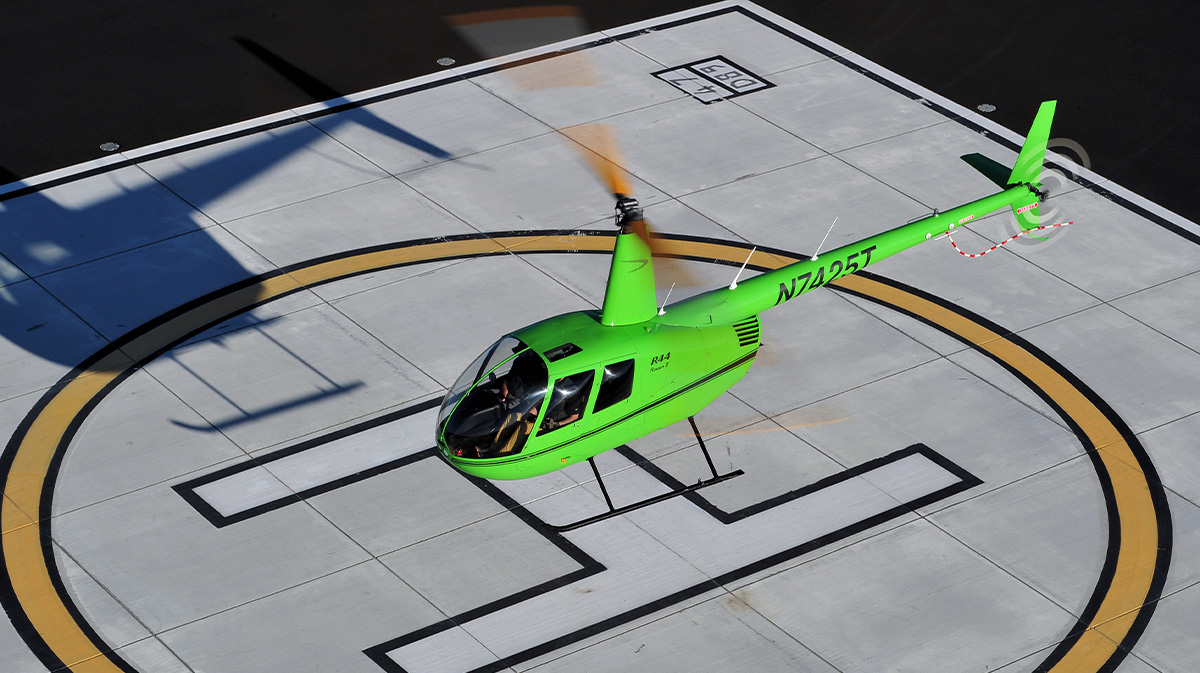
Helicopter hovering means holding the aircraft still over one spot, and it’s one of the first skills every student works on. It’s hard because the three controls are linked: moving one usually calls for an input on the others. Instructors break that down by handing over one or two controls at a time, and the corrections shrink until the hover holds.
Ask any helicopter pilot about their first hover, and you’ll get a story. The aircraft wandered across the pad, the instructor’s hands never left the controls, and ten minutes seemed like an hour. Then, in a later lesson, it held. This post explains why hovering works the way it does and how training gets you there.
What Is Hovering?
A hover is a helicopter holding a constant position, heading, and height over a fixed point, with no lateral movement. The FAA’s Helicopter Flying Handbook treats hovering as its own flight regime with its own aerodynamics, which is why it carries its own set of techniques rather than folding into normal flight.
It also turns up everywhere. A normal takeoff begins from a hover. A normal approach ends in one. Hover taxiing moves the aircraft around the ramp, and slope landings, confined-area work, and pinnacle operations all depend on holding position in wind. Students practice it in most lessons from early on, alongside everything else they’re learning.
Why Is Hovering a Helicopter So Hard at First?
Three controls do the work. The cyclic tilts the rotor disc and moves the helicopter forward, back, or sideways. The collective changes the pitch of all the rotor blades at once, which changes lift and power. The pedals control the tail rotor, which counters the main rotor’s torque and sets the heading.
The difficulty is that the controls are linked. Raise the collective to climb, and the engine delivers more torque, so the nose swings and the pedals need an input. Add pedal and the tail rotor’s thrust changes, so the aircraft drifts and the cyclic needs one. Almost every input calls for another somewhere else.
Two more mechanisms work against a new student. The tail rotor’s sideways thrust pushes the helicopter in one direction in a hover, so holding position takes a steady cyclic input toward the other side. And a helicopter responds with a short delay, so a student who waits to see a drift before correcting is already late. The handbook’s most common hover error is overcontrolling: large, late inputs that chase the aircraft instead of anticipating it.
How Do Instructors Teach Hovering?
They take some of the workload. At the start of hover training, the instructor may hand the student one or two controls and keep the rest. A student might hold heading with the pedals while the instructor flies the cyclic and collective, then take height with the collective, then position with the cyclic. The controls come together as the student is ready for them.
Where you look matters just as much; new students stare at the ground a few feet off the nose, and at that distance every twitch of the aircraft looks like a crisis. The fix is to push the eyes out to something farther off, a tree line or a hangar at the edge of the ramp, where drift reads as a slow slide instead of a blur. That’s what makes a small correction possible. Nobody locks onto that point, though. It sits loosely in the middle of the picture while the edges of your vision do most of the work.
At Leading Edge, hover work happens in the Robinson R22, our primary trainer for Private, Commercial, and Flight Instructor. It’s also the most popular training helicopter in flight schools worldwide. It’s small and light, and it rewards small, early corrections, so a student who learns that habit in an R22 carries it into every aircraft afterward. Lessons are scheduled in two-hour blocks, with an hour to an hour and a half of that in the air and the rest on the ground for preflight and debrief. Your time in the air grows as retention and proficiency build.
Jay Bunning, Leading Edge’s Director of Training, walks through hovering in depth on the Helicopter Training Podcast: How to Hover a Helicopter. It covers what each control does, the aerodynamics behind a hover, the ACS standards you’ll be measured against, and drills to practice.
What Does Hovering at 3,460 Feet Teach That Sea Level Can’t?
Bend Municipal Airport sits at 3,460 feet above sea level. Thinner air means the rotor produces less lift and the engine produces less power for the same control positions, so hovering here demands more power than the same hover at sea level. On a warm summer afternoon, the effective altitude climbs higher still.
Hover performance charts come out in the first weeks here, well before most students expect them. Students learn the difference between hovering in ground effect, where the rotor’s downwash against the surface reduces the power required, and hovering out of ground effect, where it doesn’t. And they learn to run the numbers for the day’s pressure altitude and temperature before they fly, because the aircraft that lifted easily on a cold morning in January won’t behave the same way in July.
A pilot who learns to hover in Bend has already learned to hover in the conditions that catch pilots off guard. With 300 or more days of sunshine a year, those lessons happen year-round.
Where Does Hovering Show Up Later?
Hovering doesn’t gate the rest of training. Students work on takeoffs, approaches, and traffic pattern work alongside it, well before the hover is solid, because waiting would stretch training out for no good reason.
What changes is how much attention it takes. Once the hover holds itself, it becomes a tool rather than the task. Slope landings, confined areas, and the pinnacle and ridgeline landings Leading Edge introduces in Central Oregon all come down to holding position in changing wind. The pilot who flies an air ambulance onto a highway or a utility helicopter under a power line is using the same skill, refined by thousands of hours.
See What Training Looks Like
If the helicopter training program is on your list, hovering is part of it from early on. Contact the Launch Team at launch@flybend.com or (541) 383-8825 to talk through what training looks like from the first lesson.